
Leather Care & Guides
How to Remove Oil and Grease Stains from Your Leather Jacket
Jul
Got Oil on your Leather Jacket? Worry not!
Nothing is more irritating than seeing an oil or grease stain appear on your beloved leather jacket. Whether the spot comes from cooking oil, salad dressing, or grease collected from working on your car, the natural reaction would be to immediately rub the stain off before it settles into the jacket. However, this would probably be the fastest way of making things worse.
The positive aspect of the matter is that just because there is an oil stain doesn’t necessarily mean your leather jacket is doomed to become unsightly. In some cases, it’s possible to diminish or even eliminate fresh stains provided you apply the correct technique and act promptly.
Below, we will discuss ways of removing oil and grease stains from your leather jacket safely, as well as effective methods and when it would be better to turn to the professionals instead.
Know Your Leather Before Dealing with a Stain
Oil and grease can affect leather jackets differently, depending on their types. Thus, before proceeding with cleaning procedures or applying any home remedies, it may be useful to find out which kind of leather you are dealing with. The improper application of cleaning techniques can not only fail to resolve the issue but also ruin the fabric.
Cowhide Leather
Cowhide is rather dense, durable, and tolerant of home care. As its texture is tight, the new oil stains are unlikely to penetrate deeper, if they are tackled in time. You can apply standard leather cleaning techniques with no fear of damaging the fabric.
Lambskin Leather
The lambskin leather is known to have a buttery-soft nature, but its softness means that it is more prone to damage. The oil will be absorbed by the leather very quickly, hence it is essential to dab on the oil and ensure there is minimum moisture used when removing it.
In case you are uncertain about what kind of leather it is, then you should look at the care instructions from the manufacturer. It just takes a moment of time to know what kind of leather it is.
What You Will Need
First, make sure you have all your supplies in one place. The use of proper equipment is an important aspect of safety when cleaning, and will discourage using household items that can harm the leather.
Basic Leather Cleaning Kit
- Microfiber cloths – Needed for oil and grease absorption, applying cleaner, and buffing the leather without scuffing its surface.
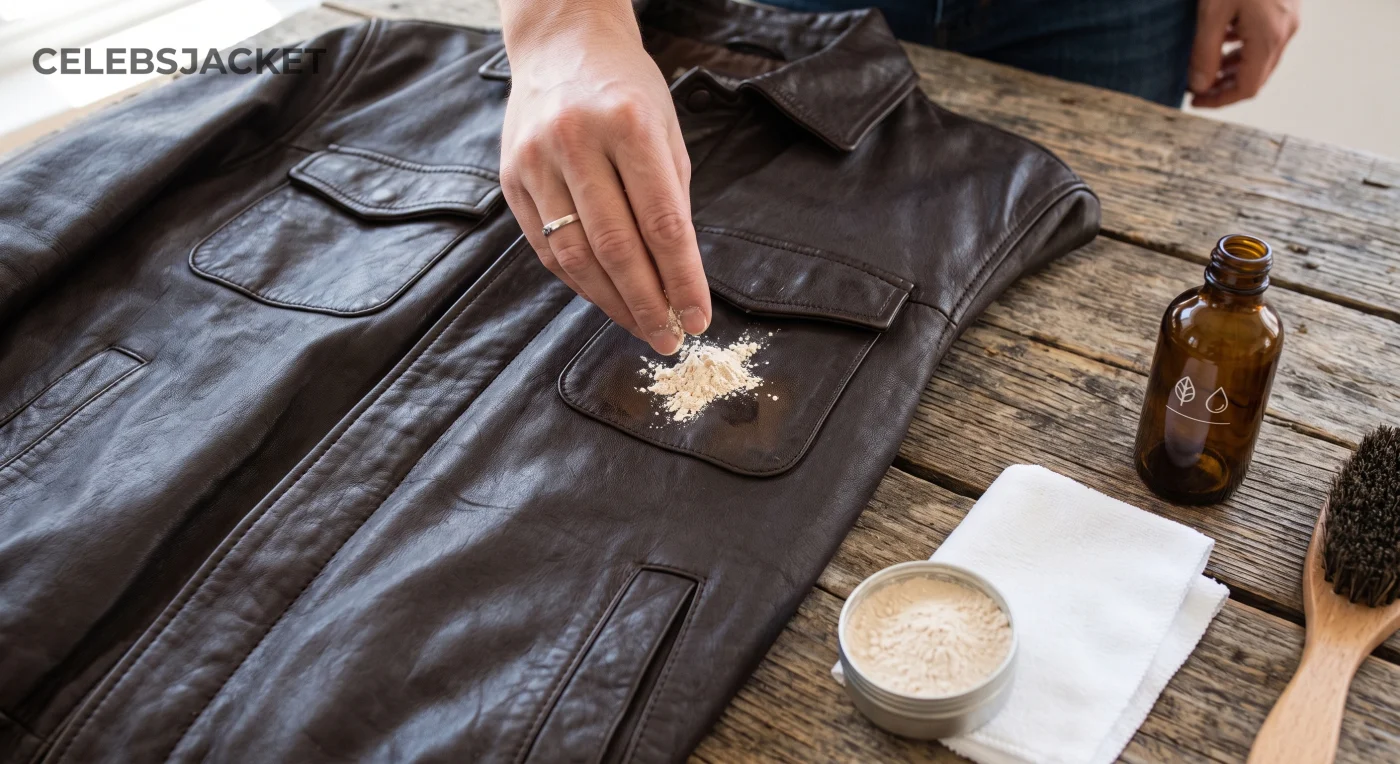
- Cornstarch/talcum powder – Can help with absorbing fresh oil and grease until it penetrates too deep into the leather material.
- Leather cleaner – Should be pH balanced, made for smoothing leather.
- Soft-bristled brush – Can be useful for dusting away dried powder from the surface.
- Leather conditioner – To restore leather moisture after cleaning.
Such preparations will help you get down to business immediately, as promptness is a very important element of successful treatment of such stains.
Step One – Blot, Not Rub
As soon as you see any traces of oil stains on the leather furniture, avoid using a paper towel or cloth to rub it. Rubbing the stain will only drive the oil further into the pores of the leather and increase the size of the stain.
Use a dry and clean microfiber cloth to gently blot the stain on the leather sofa or other pieces of furniture. Press it gently to try absorbing some oil from the stain, but do not move it around. This simple trick should help you get rid of most of the excess oil before it sets deep in the leather material.
Quick tip: It is important to act fast since fresh oil stains are significantly easier to remove than those which have had time to settle in the material for a couple of hours.
Step 2 – Removal of the Oil Through Natural Absorption
Once all excess oil has been dabbed off, it’s now time to pull out the remaining oil under the leather surface. Cover the stained portion of your leather product with a substantial amount of cornstarch or talcum powder. The use of these powders is quite effective in removing oil from the leather surface due to their natural absorption ability, which prevents the use of scrubbing and water in the cleaning process.
Keep the powder on for at least 4 to 8 hours or overnight for more stubborn stains. After sufficient time of allowing it to absorb the oil, dust off the powder using a soft-bristle brush or a dry microfiber cloth. In case the stain is lightened but not yet fully removed, do not opt for harsher cleaners right away. Instead, consider another application of powder.
Step 3 – Clean the Surface
Now that you have got rid of all the oil, the leftover traces will be present on the leather surface itself. This is the step where using a specialized leather cleaner can help remove the remnants without damaging the natural coating on the leather surface.
Pour a small quantity of pH-neutral leather cleaner on a soft microfiber cloth but never directly on the leather jacket. Rub the affected spot in light circular motions, making sure not to apply too much pressure in the process and blend the cleaner into the leather from the adjoining area.
It is better to do less rather than too much if the spot has already become considerably lighter after being treated with the absorbent powder, do not continue the cleaning procedure. Excessive cleaning will lead to drying of the leather surface, which is not what you want to achieve.
Step 4 – Conditioning of the Leather
Now that your jacket is totally clean and dry, you may condition the leather to replenish moisture that might have been lost through the cleaning process.
Apply a small amount of leather conditioner on the clean patch using a soft cloth. Next, blend it over the patch until it reaches the surrounding leather panel uniformly. Ensure that you allow the leather to absorb the product naturally as per the manufacturer’s guidelines. Afterwards, use a clean, dry microfiber cloth to buff any excess product from the leather.
It is important to note that conditioning the leather is not about moisturizing or adding shine to the leather, so you should avoid using too much product since this could make the leather look greasy.
Oil Stain Removal Blunders
If there is a stain on your clothes, you will be tempted to clear it up as fast as you can. However, that tendency usually ends up doing more harm than good. These are some typical errors that should be avoided while removing oil stains.
| Mistake | Why It Backfires | What to Do Instead |
| Over Scrubbing the stain | Oil will be pushed further into the leather pores and could become more widespread. | Clean the stain by blotting it gently with a soft microfiber cloth. |
| Applying dish soap or any cleaning product | These products may not be suitable due to the risk of removing the protective layer on the leather. | A specialized pH-balanced leather cleaner should be used for smooth leather. |
| Using heat to dry leather with a hairdryer or heater | The intense heat can dry out the leather, leading to stiffness or cracks. | The jacket must be allowed to air dry at room temperature. |
| Dipping the leather in water | Too much water could cause water spots or deformation of the leather. | Only use a slightly moist cloth when necessary. |
| Repeated application of the cleaning procedure | Over-cleaning may remove oils from the leather, making it look dull. | When the stain becomes lighter but remains present, cleaning must stop. |
The ideal repair is not done with the most powerful cleaning technique but the safest. Often, it works best when you have the patience to do things gently.
When Home-Based Care is Not Enough
Certain types of oil and grease stains cannot be effectively removed by using only home-based care methods. If the stain has existed for a number of days, has become embedded deep in the leather fabric, or if it occupies a wide area on the jacket, continued attempts at cleaning will only cause further damage.
Specialized products and leather cleaning professionals have ways to effectively remove stains from leather fabric without causing any changes to its color and appearance. This approach is particularly useful if one wants to preserve a high-end, vintage, or valuable item since the price of professional cleaning is much lower than that of buying another jacket.
If you tried all of the methods listed above and still have not seen any progress in the stain removal process, take it as a hint to stop trying rather than as an invitation to use harsher cleaning agents.
Final Thoughts
Oil and grease stains are often easy to treat with the proper procedure: blot, absorb the oil, clean gently, and replenish leather with a conditioner. It is not about using harsher products but about using more gentle methods when the stain is still new and hasn’t had time to settle.
Even though this guide concentrates on oil and grease stains only, proper maintenance is as important as treatment of stains. Discovering how to clean your men’s leather jacket, condition it, and maintain various types of leather properly can prevent many troubles in advance.
If you want to learn about complete maintenance of your leather jacket, keep reading our guide How to Clean a Leather Jacket at Home – The Complete Step-by-Step Guide.
