
Guides
How to Clean a Leather Jacket at Home – The Complete Step-by-Step Guide
Jul
Introduction – The Fear That Every Leather Jacket Owner Knows
It always begins with something minor.
Coffee that stains during your commute to work. Dust accumulates after wearing the jacket for weeks. Water marks caused by the unexpected rain. You spot the stain, grab a cloth – and hesitate. For the first thing that pops into your mind is:
“Can I clean my leather jacket on my own or will I spoil it?”
This is completely understandable. As opposed to cotton or denim, leather is a natural material which undergoes transformation over time. Each piece gets its own unique texture while wearing; if cleaned improperly, it loses its natural oil, gets faded, and acquires stains much more visible than the one that you tried to clean.
What’s good, most men’s leather jackets can be safely cleaned at home if done with proper care and understanding of the material. Whatever type of leather jacket you have – cowhide, lambskin or other kind of genuine leather jacket – cleaning of the jacket is not the process of applying powerful cleaning solutions but rather a careful approach.
Here, you will get to know about all the processes for identifying the kind of leather on your jacket, putting together the right cleaning kit, getting rid of the dust and stains from your jacket, drying your jacket, and moisturizing it using conditioning. Also, you will get to learn about the differences between cowhide leather and lambskin leather jackets, common mistakes to avoid, and when to let an expert leather cleaner take over your jacket.
Your aim should not be to make the leather jacket look like a brand new one. Your aim should be to treat your jacket in such a way that will preserve its finish and charm for many years.
Before You Start – Know Your Leather Type
Before reaching for the cleaner and a wet rag, it’s essential to determine what kind of leather your jacket is made of. The identification of the type of leather is crucial as there are various types of leather that have different reactions to moisture, cleaning solutions, and conditioning.
The inappropriate treatment method does not necessarily harm a jacket once applied, yet it might affect the jacket’s appearance in the long run. While one solution can safely be used on certain kinds of leather, it may cause damage or just do no good for others.
Most of the men’s leather jackets are either cowhide leather, lambskin, or suede leather. Each has its own features, requirements for maintenance, and level of tolerance towards being cleaned in domestic conditions. Learning all of this will help you select the safest way to clean a leather jacket further down the road.
In the next paragraphs, we will analyze how each type of leather behaves, what sets it apart, and what you need to know regarding the cleaning process.
Cowhide Leather
With cowhide leather, you are using the type of leather which is the strongest and most flexible when compared to other types. The dense nature of its fibers makes it strong enough to stand up to everyday use. It is used to make jackets that can be worn as motorcycling outer clothing, work wear, and other types of real leather jackets that will look great in the coming years.
The same durability makes cowhide leather more resistant to the effects of home cleaning than other leathers which are more delicate in nature. Cleaning it is easy as a damp microfiber cloth, mild leather cleaner and conditioning is all that is needed to clean any type of dirt accumulated on the jacket.
The most favorable feature about this leather is its reaction to maintenance. Through regular cleaning, the dirt, dust, sweat and other contaminants are removed before they penetrate into the leather grain while occasional conditioning restores the moisture without altering the structure of the leather. In this way, not only will it maintain its integrity but enhance its beautiful characteristics too.
Although cowhide is durable, do not consider it maintenance free. The use of harsh brushes, common household cleaners, or too much conditioner may harm its appearance. Gentle treatment will always yield more desirable effects than forceful cleaning methods.
Lambskin Leather
Lambskin jackets are known for being especially soft, light, and elegant. As compared to cowhide, lambskin has more delicate and fine grain, which makes it an ideal material for fashionable men’s leather jackets, in which style and comfort take precedence over practicality.
However, that same softness and delicateness imply certain peculiarities when it comes to cleaning the jacket. Indeed, lambskin is more absorbent and susceptible to scratches and other damage caused by rough handling. Thus, the aim is not to clean the jacket thoroughly by scrubbing off all the marks, but rather to perform as gentle cleaning as possible without ruining its natural look.
Here are some tips you should follow while cleaning your lambskin jacket:
· Minimize moisture. Do not use too much water in your cleaning cloth.
· Use only leather-specific cleansers. Regular household cleaners will wash out leather’s natural oils.
· Avoid over-rubbing. Wiping is always safer than scrubbing.
· Apply conditioner moderately. Moisturizing is good for lambskin, but too much conditioner can make the leather heavy and change its soft nature.
Due to the higher sensitivity of the lambskin compared to the cow leather, you should take your time to do it right. The process of cleaning the leather slowly and carefully will prove to be much more productive than trying to get all the spots out in one go.
Suede and Nubuck
Although suede and nubuck might appear to be very similar at first sight, they both are quite different from smooth leather as far as durability is concerned since these materials are far more susceptible to water, spots, and rubbing. However, precisely because of the texture that provides such a unique look to these jackets, there is an entirely new approach to be taken into consideration.
These types of leather can’t be cleaned with too much moisture as well as in the same way as cowhide or lambskin. Moisture might flatten down the nap of suede and nubuck which is the velvety coating on the surface, and also cause discoloration and water spots.
Dry or low-moisture cleaning should always be considered as the first option in cleaning such materials.
To maintain your suede or nubuck jacket, here are some tips for you:
· Clean up the nap of the leather by brushing it with a suede or nubuck brush.
· Treat any spots immediately by using appropriate products.
· Apply moisture only if the product manufacturer recommends it, and try it out on a small area before applying to the jacket itself.
· Allow the jacket to air dry after it has been washed.
As suede and nubuck are less forgiving than smooth leather, these two types of leather can also gain from being professionally cleaned if the stains are particularly tough to remove. Being careful will help maintain the texture that is the characteristic feature of these materials.
How to Identify Your Jacket’s Leather
Before you proceed to clean the jacket, it would be worthwhile to spend some time establishing the kind of leather your jacket is made of. Depending on the type of leather, there will be different methods of cleaning and if you make an assumption that happens to be incorrect, the process itself may damage the material more than the stains do.
Start from the easiest test, and then move on to the next one until you can identify the material.
1. Examine the Care Label
You can start with the care label in your jacket because many brands will indicate what type of leather their jackets use, whether it is cowhide, lambskin, suede, or nubuck. If the care label contains information about the cleaning procedure, take it as a starting point, because it is tailored just for your jacket.
2. Feel the Leather
Often, the touch will reveal what kind of leather your jacket is made of.
· Cowhide is firm, thick, and durable material that maintains its shape and weight.
· Lambskin is soft, smooth, and thin; it has lightness and flexibility.
· Suede and nubuck are both characterized by a brushed and velvety look.
3. Check the Leather Surface
Different types of leather age differently too.
· Cowhide ages well, developing creases and gaining a patina but retaining its durability.
· Lambskin continues looking smooth but can develop scratches and creases.
· Suede and nubuck are matte with a raised nap that feels slightly different when brushed.
4. Still Uncertain? Ask First!
When your jacket does not have a label, is second-hand, or if you are unsure about the type of leather, do not test different products on it. Contact the manufacturer, the store where you bought it, or a leather cleaner for advice before you start applying any product.
It takes only a little more time to figure out the type of leather you have rather than risk damaging it with inappropriate products. After that, it will be easier to follow this guide.
Using an extra few minutes for identifying your leather is certainly more secure than fixing the damage that could have been done using the wrong technique. Now that you have identified your leather correctly, following this guide will be easy and safe for you.
What You’ll Need – The Essential Cleaning Kit
The proper choice of products is equally important as the correct technique. Leather does not need an elaborate arsenal of care products, but it does deserve soft and mild substances that will clean it without harming its natural oils or finish.
The list of supplies needed is as follows:
· Two microfiber cloths – One for cleaning and one more for drying or polishing. Microfiber is safe to use as it won’t scratch leather.
· Special pH-balanced leather cleaner or mild soap – Whenever possible use a cleaner meant for leather. If there’s a need for soap, use mild liquid diluted in water. Avoid any products containing bleach, ammonia, and strong detergents.
· Small bowl of lukewarm water – It’s better to damp the fabric, not soak it, as extra moisture is extremely harmful for leather.
· A brush with soft bristles (optional) – For dusting the seams, stitches, and hardware prior to cleaning.
· A high-quality leather conditioner – To be applied after cleaning, to moisturize the material.
Do not use any regular household cleaning agents like glass cleaners, disinfectants or sponges and all-purpose sprays.
Step-by-Step – How to Clean Your Leather Jacket at Home
It is not a question of racing through each process while cleaning the leather jacket; rather, it is a matter of preparing the leather in such a way that the subsequent process can take place effectively, thus removing any dirt without damaging the protective properties of the jacket.
Perform each of the steps listed below sequentially, and don’t be tempted to jump ahead.
Step 1 – Preparation
Before using the cleaner, be sure to prepare both your workspace and the leather jacket. It will take just a few minutes, but it greatly decreases the chance of unintentional damage during the process of cleaning.
This short list will be helpful to follow:
· Empty all pockets. Any object placed inside of the jacket may lead to stretching of the leather or changing its shape when cleaning.
· Get rid of dust and debris. Use a dry microfiber cloth to wipe the jacket or a soft bristled brush for seams, pockets, and zippers.
· Check your jacket under good lighting conditions. Take time to identify spots which require special cleaning so you can take care of them separately and not wipe your jacket several times.
· Spot test your cleaner. Apply a small amount of the cleaner to an inconspicuous spot on the inside hem or the collar. Give it a minute to see if there is any discolouration or undesired effect.
Pro Tip: Be patient and do not try to clean the whole jacket right away. Even though spot testing seems like an unnecessary step, it might help you save your jacket from getting irreparably damaged
Step 2 – Spot Cleaning Stains
However, prior to treating the jacket as a whole, consider removing individual stains on it first. Such an approach will allow you to avoid spreading dirt all over the jacket and pay special attention to the areas that require more effort without over cleaning the others.
Dip the microfiber cloth in the leather cleaning agent or mild soap dissolved in water, but never apply the product directly onto the jacket. Gently massage the outer edges of the stain in a circular motion to avoid spreading it.
It is important not to scrub the stains vigorously because leather is not a regular material and such treatment may damage the coating. Do not try harder in case the stain did not come out in a few gentle attempts because it may only worsen the situation.
Finally, wipe the stained area dry using a damp cloth to avoid leaving the cleaning agent on the surface of the leather.
Keep in mind that not all stains are always removable by means of household cleaning. Paint, ink, grease, and deep stains require special care, and the attempt to remove them might be even more damaging than the stain itself.
Step 3 – Clean the Entire Jacket
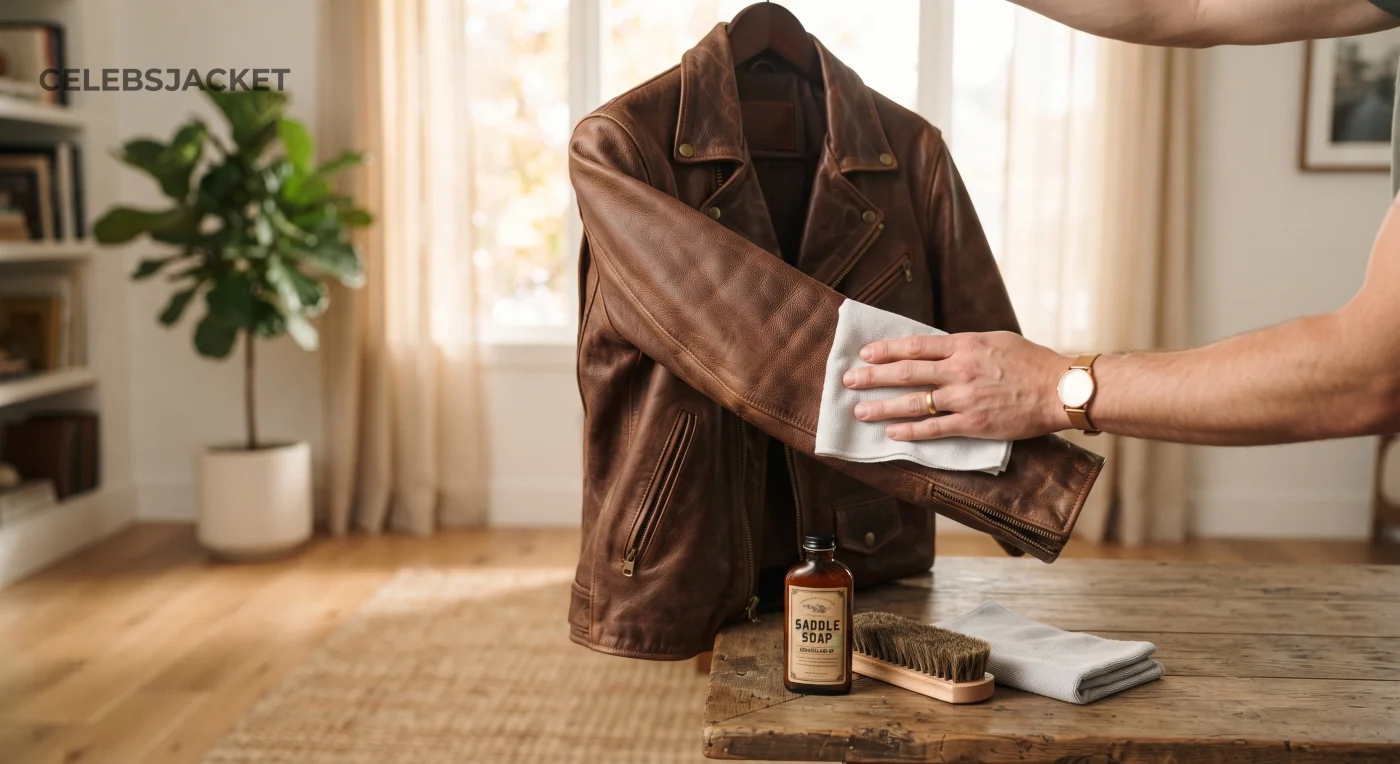
After treating stains on the leather, now is the time to clean other parts of the jacket. Soak a clean microfiber cloth with leather cleaner or soapy water but make sure the cloth is only damp and not wet.
Clean leather by applying the dampened cloth in gentle circular motion or stroke in the direction of the grain. Start cleaning from the shoulders and slowly move down to the lower part of the jacket, focusing on areas where stains can easily build up like collar, cuffs, and pockets.
If the cloth is dirty, rinse the cloth or use another clean piece of cloth.
Don’t scrub the leather and avoid repeating cleaning of the same area. Gentle cleaning is better than vigorous rubbing of the leather. If there are hard stains on the leather, deal with them at another time.
Step 4 – Rinse and Remove Soap Residue
Once you have completed the cleaning step, you will now use another microfiber cloth that has been slightly moistened with clean water to gently wipe the jacket. This will eliminate any cleaner residue from the leather that may otherwise dry up and interfere with the quality of the leather jacket.
The microfiber cloth should just be slightly damp, not soaking wet. It takes just wiping to get rid of any residue.
Now check the jacket for any residue left behind by the cleaner. In case there is any, simply repeat the procedure using another part of the microfiber cloth.
At this point, the leather jacket is supposed to look clean but not soaked.
Step 5 – Dry the Jacket Correctly
Once you have cleared off any cleaning solution from the jacket, let it dry naturally in a room that has proper ventilation. You should hang it on a broad, padded hanger to ensure that its shape is maintained throughout the drying process and that any residual moisture is allowed to evaporate evenly.
Make sure that the jacket does not come into contact with the sun’s rays, a radiator, a hair dryer, or any other form of heat. Although heat might be a way to accelerate the drying process, it will cause the leather to lose all its natural moisture, resulting in it becoming rigid, brittle, or prone to cracks after some time.
It will take some time for the jacket to dry completely because it will feel cold or damp for quite some time. This is perfectly natural and you just need to wait until it is dry completely.
Quick tip: Patience is one element of taking good care of leather.
Step 6 – Condition the Leather
Once you have dried off the jacket entirely, you should consider using a good leather conditioner. Leather conditioning is the process where the leather jacket gets flexible and prevents it from drying up. Conditioning is not the process where the leather looks glossy.
Apply the conditioner lightly onto a microfiber cloth and use this to spread on the leather. The whole jacket doesn’t have to be heavily coated; usually, it just needs a slight coat all over.
Allow the product to settle as indicated by the manufacturer before buffing it off with another dry cloth.
Conditioning is better done when applied minimally; over-conditioning will not give the desired result of making your jacket softer and increase longevity. Excessive application of the conditioner will make the leather jacket greasy, easily dryable, and will change its look.
Cowhide vs. Lambskin – The Cleaning Difference
Whereas the process of cleaning itself is consistent, cowhide and lambskin react differently to the process of care. This knowledge will assist you in taking care of leather without damaging its individual characteristics.
| Cleaning Factor | Cowhide | Lambskin |
| Durability | The leather is dense and durable, thus being more lenient during cleaning. | The leather is soft and delicate and hence needs to be handled with care. |
| Resistance to Moisture | Tolerant to moisture if dried correctly. | Tolerates moisture less and hence should not be exposed to moisture. |
| Resistance to Scratching | The scratches can fade away within time due to its grains. | The scratches on lambskin are very noticeable and hence need to be taken care of. |
| Need for Conditioning | The cowhide requires conditioning once or twice per year. | The lambskin does not require any conditioning and over-conditioning is discouraged. |
| Cleaning Methods | Suitable for frequent cleaning with good leather cleaners. | Clean occasionally with low-pressure and moisture. |
None of the two are particularly demanding to take care of; they only need to be treated differently. While cowhide is easier to work with and takes on character with age, lambskin maintains its luxury if you treat it carefully.
Neither stronger cleansers nor harsher methods lead to better results. You just need to know what kind of leather your jacket is made of and treat it accordingly.
Frequently Asked Questions (FAQs)
Can I put my leather jacket in the washing machine?
You can’t. It is never recommended to wash leather jackets in a machine washer since such a combination will take away all natural oils from the material, deform its structure, and cause the jacket to become rigid, crack, or shrink during the drying process.
If you need to maintain your jacket on a regular basis, clean it by hand with a leather cleaner and moisturizer using a damp microfiber cloth. Otherwise, use professional leather cleaning services for heavily soiled items.
How often should I clean my leather jacket?
There’s no set timetable for this either. The typical leather jacket can get by fine with a bit of a cleanup every several months in order to eliminate dust and dirt from the surface.
Don’t worry about how many times per month you need to clean your jacket. How often you wear it, what conditions it gets into, and whether you take the time to wipe it off will make a bigger difference than any kind of deep clean.
Can I use vinegar to clean my leather jacket?
This may vary but is not usually the first course of action. Although white vinegar diluted can be recommended for removing some surface spots, it can make the leather dry if used too often and in an improper concentration.
The use of a pH balanced leather cleaner will be the safest way to remove stains from leather without damaging its natural finish. However, when using diluted vinegar on particular stains, you should first test it in an inconspicuous place and then apply leather conditioner after drying the jacket.
If you have any doubts, it is always preferable to use products for leather.
What’s the best leather conditioner?
A good leather conditioner would be one that suits the specific type of leather on your jacket. This should be a good quality conditioner which nourishes the leather but does not leave any heavy greasy buildup. Conditioners which use natural waxes and conditioning oils will be effective for the smooth leather, as long as the instructions by the manufacturer are followed.
You should stay away from household oils or quick-fix solutions that make your leather shiny, as these might change its look and make it attract dust. Just keep in mind that no matter how good your conditioner is, it will be effective only when you apply it sparingly a couple of times per year.
How do I remove water stains from my leather jacket?
Water marks can be caused by the uneven drying of moisture on the leather surface. It is best to deal with these problems at once; otherwise, their effect becomes more visible.
Wet a soft microfiber cloth with distilled water and clean the market place, slightly extending it to form a uniform layer of moisture. Let the jacket dry naturally by hanging it in a suitable place with no source of heat or sun.
After the drying process, use some leather conditioner to help the leather retain its natural suppleness.
It is not recommended to continue washing the stained places with water in case they still remain visible or take up too much space.
When to Call a Professional
House cleaning is best for regular maintenance and minor issues. Not all things, however, need to be done in the comfort of one’s home. Knowing when to quit is just as crucial as learning how to clean.
Think of having your jacket professionally cleaned if it features:
· Deep and penetrating oil or grease stains.
· Transferred ink, paint, or dye which does not come off easily.
· Signs of mold or mildew due to exposure to water.
· Extensive water damage, discolorations, or odor.
· Vintage or valuable leather that you would rather not risk cleaning yourself.
What makes professional cleaners an excellent option is that they have access to special cleaning procedures, color restoration treatment, and leather conditioner products that cannot be used for personal cleaning at home. The downside is that professional cleaning costs more than DIY house cleaning.
Generally speaking, maintenance can be done at home; restoration needs a specialist.
The Bottom Line – Your Jacket, Your Responsibility
There is no need to make your leather jacket look like new after each cleaning procedure because the goal of any cleaning process is to remove dust and dirt from your leather jacket to prevent its damage, maintain its natural properties, and provide necessary care.
No matter whether you have a tough cowhide jacket or a luxurious lambskin jacket, this rule works for both. Gently clean it and condition it if needed, do not try to take shortcuts, promising fast results but damaging the leather jacket in the long run.
For those who are interested in the effect of care procedures on the aging of leather jackets, we recommend reading our article titled “The 5-Year Patina Test: Cowhide vs. Lambskin – Which Ages Better?” It explains how proper care affects the aging process of leather jackets.
The quality of your men’s leather jacket is not measured by the degree of perfection but the way you take care of it.
