
Leather Care & Guides
Leather Jacket Repair: When to Handle the Problem on Your Own, and When You Need Help
Jul
Introduction
Just one torn piece, broken zipper, or peeling spot can have you thinking that you will need to replace your precious leather jacket soon. Fortunately, this isn’t always true. Most leather jackets are fixable, and there is a good chance that even with the damage, it could remain beautiful for decades more.
The trick is in figuring out what kind of damage your jacket has sustained. In some cases, such as loose stitching or light scratching on the surface, there is no reason why you cannot repair your jacket at home. In other cases, however, such as large tears, damaged lining, or cracked leather, you will need to turn to professionals to prevent further problems.
Here, we will describe common leather jacket repairs, what you can repair yourself, and when you will want to call on the help of a leather repair specialist.
Begin with Evaluating the Situation
Do not rush into using any glue or patch until you analyze the situation. Leather is a natural product, and not all signs of wear should necessarily be “treated.” Some of the marks on the leather are merely an effect of its aging.
Just ask yourself several basic questions:
- Is the defect merely cosmetic or more serious?
- Does it involve the leather tearing or does it have only scratches?
- Does it affect zipper, lining or sewing?
- Did the leather get dry or cracked?
The analysis will help you pick up the correct approach instead of unnecessary treatment.
Small Scratches Are Easily Repairable on Your Own
A very common issue is that of scratches. However, light scratches do not always necessitate any major restoration.
Sometimes all that it takes is simply rubbing the affected area using your fingers for the oils from the leather to heal the scratch. Otherwise, if you want a more permanent solution, try applying a good leather conditioner to make the scratch barely visible.
However, remember that deeper gouges are an entirely different story – if the leather fibers have been affected, no amount of conditioner alone will be able to fix the area.
If there are light scratches:
- Clean the area.
- Apply a small amount of leather conditioner.
- Buff using a microfiber cloth.
- Let the leather soak the conditioner before use.
It is always advisable to treat the scratches earlier since this results in a better outcome.
Small Tears Require Prompt Attention
The minor tear may not necessarily appear serious, but leather does not usually mend itself. Each use of the jacket subjects the tear to stress and makes the hole bigger.
In cases of minor tears, leather bonding agent and a lining patch can save the material from additional damage until proper mending is done. But using excess glue or common adhesives can make the leather discolored or tough.
In case of a minor tear that occurs in areas where it will be highly noticeable like on the chest, shoulder, or sleeves, professional mending gives a clean appearance.
Never Neglect Loose Stitching
There may be no damage at all on the leather—it’s in the stitching.
Stitching becomes weak after many years of normal usage, especially near the pockets, cuffs, and under the arm holes due to constant movement.
If there are signs that the stitching is starting to unravel, do not keep wearing your jacket; a slightly separated seam can be fixed much better than a fully separated one.
The symptoms of stitching damage are:
- Loose threads.
- Seams unraveling.
- Gaps emerging in the seams.
- Uneven stitching due to heavy wear.
Early replacement of stitches is essential for maintaining the shape of the entire jacket.
Does a Faulty Zipper Mean That the Jacket Should be Replaced?
One of the most common mistakes of many people is assuming that once the zipper stops working, it is time to replace the jacket. However, it should be mentioned that zippers are one of the easiest parts to fix.
It can be just worn out zipper slider or bent or even lost teeth that make a zipper malfunction. Nevertheless, it is possible to replace it without damaging the overall look of the jacket.
Is It Possible to Repair Cracked Leather?
One of the most problematic things about cracked leather is that it happens gradually. Leather loses moisture naturally due to aging process and the fact that it is being subjected to the sun, heat, and improper storage conditions.
Once deep cracks appear, there is no way to restore the leather back to normal condition; however, its appearance can be fixed using fillers and coloring agents.
Prevention is better than cure.
Cracking can be avoided through the following tips:
- Condition your leather jacket every several months.
- Hang it using a wide hanger.
- Ensure that it is not exposed to direct sunlight.
- Dry it using low heat.
- Do not store your leather jacket when wet.
It is much easier and cheaper to prevent than repair any damage caused to the leather jacket.
Repairing the Lining
While the leather exterior of the coat may be in pristine condition, the interior lining of the coat starts wearing out.
This may happen even after several years of use and it doesn’t indicate that the jacket has served its lifetime.
Repairing a torn lining can help make the jacket comfortable and extend its life for several years. This type of repair job requires dismantling parts of the jacket and thus should be done by a leather tailor only.
If the leather exterior of the jacket is healthy enough, then lining replacement can definitely be considered.
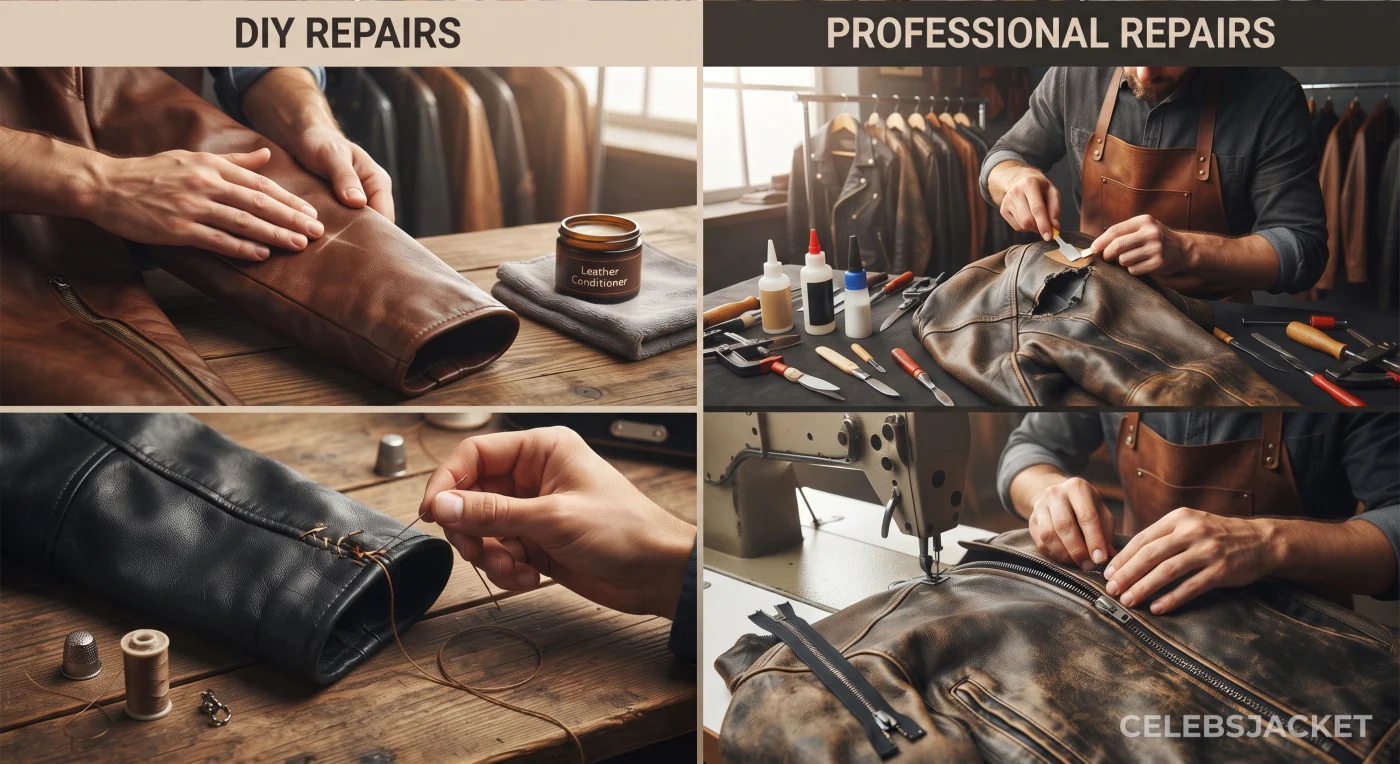
DIY Fix vs. Professional Fix
While not all repairs need professional attention, knowing when to stop can save you time and trouble.
DIY repairs can be done in cases where there is:
- Surface scratch repair.
- Cleaning prior to repair.
- Application of leather conditioners.
- Touching up by using leather repair items.
Professional repairs should be opted in cases of:
- Tear repair.
- Hole repair.
- Zipper repair.
- Panel repair.
- Color repair.
- Crack repair.
- Replacing lining.
In case you are confused, professional repair is always preferable.
What Should Not Be Done
When trying to fix leather items, well-meaning actions may make matters worse.
Things that should be avoided include:
- Using super glue and other household adhesives.
- Using too much water.
- Aggressively sanding the leather.
- Using shoe polish instead of leather repair kits.
- Neglecting minor problems.
Such shortcuts can cost more money in the end.
Is it better to Repair?
Often, people ponder whether it is better to repair or replace their damaged leather jackets.
In most cases, it will be better to choose repair because of its practicality, especially for genuine leather jackets. High-quality leather is meant to serve long enough for repairs to be reasonable.
Repair is recommended when:
- The leather is in good shape.
- The damage is localized.
- The jacket is valuable to you.
- Replacement is much more expensive than the repair.
While fast fashion jackets may not always warrant costly repairs, premium leather jackets often do.
Frequently Asked Questions
Can I really mend my ripped leather jacket?
Yes. It is possible to repair most tears, but the end result will depend on the size, place, and state of the tear on your leather jacket.
How much does it cost to repair my leather jacket?
Repair charges are not constant and are dependent on the damage to be repaired. Some of the repairs, such as simple mending or stitching, are cheaper than others like replacing zippers, lining, or color.
Can the cracked leather soften?
Softening cracked leather may be achieved through conditioning, although the deep cracks in the leather cannot be reversed.
Should I repair an old leather jacket?
Yes. There is always a possibility to repair an old leather jacket since many leather jackets that are old still have good quality leather.
Conclusion
Just because your leather jacket has gotten some damage does not necessarily mean that you have to give up on it. Most commonly occurring issues, from loose stitches to broken zippers and even minor scratches, can be easily fixed with the proper repair technique.
The key lies in determining the exact type of damage so that you know how to best fix it. While certain repairs can be done without much difficulty on your own, other more complex repairs should definitely be left to a specialist.
