
Leather Care & Guides
How to Remove Water Stains from Leather – Cowhide vs. Lambskin
Jul
Why Does Water Leave a Stain On Leather?
One may wonder how such an innocent substance as water leaves a stain on leather. It seems weird since water is used to clean any number of things. However, in case of leather clothing, a drop of rain, a splash of a beverage or even damp clothing sleeves leave spots and stains which didn’t exist until then.
The great thing about the water stains is that they don’t necessarily indicate permanent damage to your leather jacket. In most cases, the water marks appear only because of an unequal moisture absorption or some mineral residues left when the water evaporates. Knowing the reasons for the stain appearance, one will be able to eliminate it easily.
This article will explain the causes of water stains on leather, different properties of cowhide and lambskin, and also the safest way to get rid of the stains on leather jackets.
Why Does Water Create Rings Instead of Vanishing?
The logic behind this phenomenon seems questionable. How could the clear water make such marks on your leather jacket once it dries up?
The key factor here is not water but, instead, *the way the leather dries*.
As a rule, when just one part of a jacket gets wet, it will absorb moisture differently from other parts. Thus, after evaporation, the result won’t be evenly balanced but will create either a pale circle, a darker spot, or some other type of irregularity due to moisture drying out in an unbalanced way.
In addition, the type of water influences the appearance of such stains. In case of hard water, mineral deposits may appear on the surface of the leather after evaporation and cause the formation of marks. Simultaneously, the moisture can influence the distribution of the natural oils of the leather and create lighter and darker spots until the leather surface is balanced again.
It explains why intensive scrubbing cannot help get rid of water stains as the problem is not dirt but the lack of balance.
Consider the water stain as being simply an imbalance in the drying process. Often, all it requires is the fixing of this imbalance to bring back the look of your jacket.
Water Marks – How They Vary Depending On the Leather Jacket Used
A water mark is not created equal depending on what leather jacket it comes into contact with. Although both cowhide and lambskin are capable of creating water marks, how they react and can be restored varies in nature.
| Feature | Cowhide Leather | Lambskin Leather |
| Reaction to Water | More resistant to water and will not show immediate effects on its surface. | It will absorb moisture faster, making water marks easily visible. |
| Visible Water Stains | Stains caused by water appear as light stains that tend to fade once the leather has dried up evenly. | They take more time to disappear due to their dark nature. |
| Cleaning Procedure | Generally responds well to soft water-based cleaning approaches. | Requires a more delicate cleaning procedure with reduced water content to prevent affecting the finish. |
| Time to Restore | Usually tends to restore itself back to its original state faster. | Tends to take a longer time to be restored. |
Neither leather is “better,” they just react differently. The cow hide jacket is less sensitive to water and rain than the lambskin, which requires a gentle and cautious cleaning approach to preserve its soft surface.
The lesson here is not that you should wash them differently because the leather comes from different animals. The lesson here is to understand their sensitivity to water.
Method 1 – Even out the Moisture before it Dries
This seems quite paradoxical, however, one of the most effective methods for removing water marks is actually to slightly re-moisturize the affected region. This is due to the fact that such a mark is usually created not due to dirt, but because of the unbalanced evaporation of the liquid.
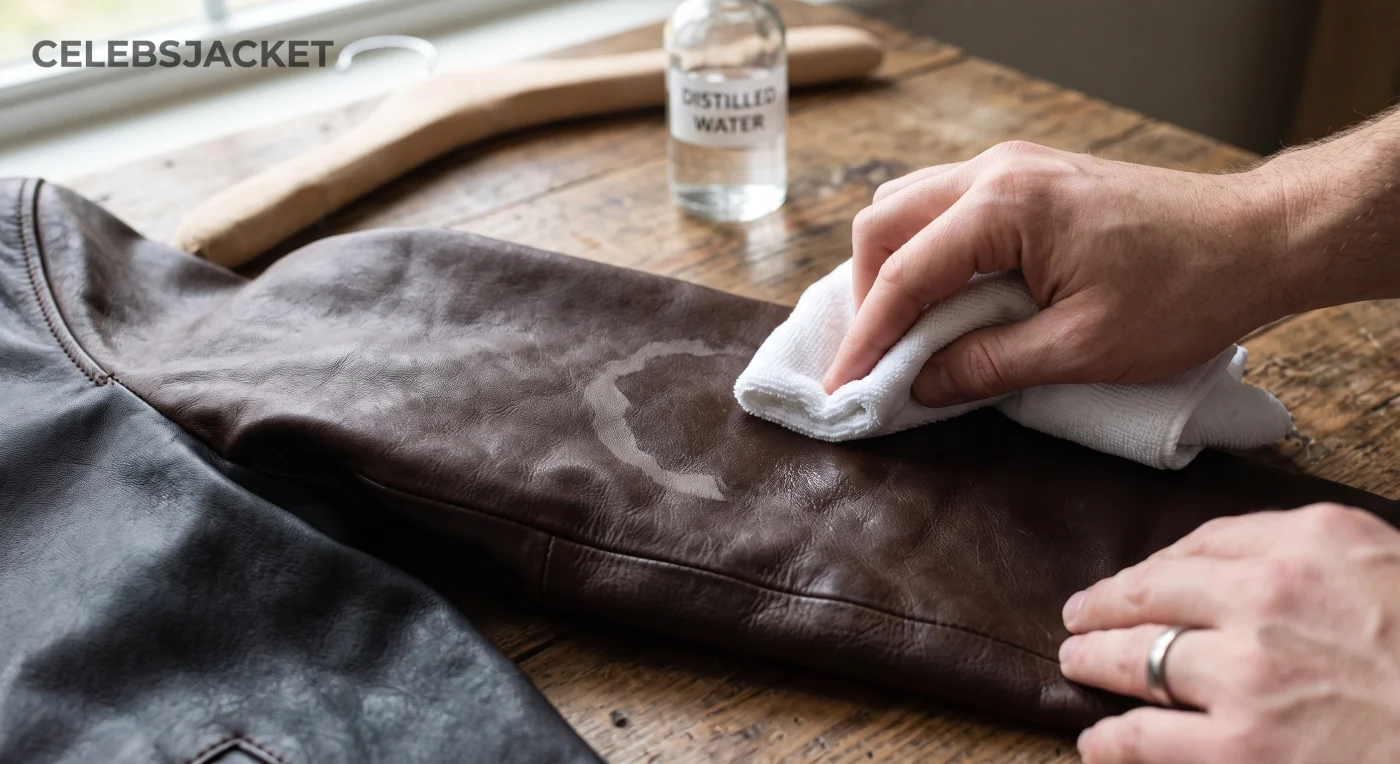
Gently moisten a clean microfiber cloth with *distilled water* rather than regular water, since minerals contained in the latter might create some other marks. Gently apply water over the edge of the mark to make sure the moisture is spread evenly throughout the whole surface.
Do not soak the material or wipe the same spot repetitively; simply keep the surface slightly moistened. When done, hang your jacket on a wide padded hanger to dry it naturally without exposure to sunlight and radiators.
Distilled water, why is this used? In comparison to hard water, which can leave water marks on the leather once dried, distilled water does not contain minerals within it.
Method 2 – Allow Leather to Dry Correctly
Removing water stain from the leather surface is not the final step. How it will dry afterward is crucial for even disappearing or reappearance of this blemish when the material will become dry.
Having smoothed all the water marks, hang the jacket on a wide and padded hanger in a well-aerated room and leave it to dry naturally. Do not attempt to accelerate the process using hair dryer, radiator or direct sunlight since fast evaporation can lead to unevenness and thus, to the emergence of new water marks, not to mention that such drying can make leather rigid.
During the time when the leather is drying, try not to fold it, put it on some flat surface or wear it until it is absolutely dry. It is important to keep the shape of leather natural in order to avoid unnecessary creases but let it be aerated well.
It may take a few hours depending on the thickness of the leather and the quantity of absorbed water. The slower process of drying is more favorable for the leather surface.
Quick Check: The leather must be totally dry before going into the conditioning process. In case there are areas that still feel cool or slightly wet, wait for some more time.
The Last Thing to Do – Help the Leather Re-balance Itself
When your jacket is totally dry, take a minute to examine the leather prior to applying a conditioner. It doesn’t necessarily mean that the treatment of the water stain will require a conditioner right away. If the leather is soft, elastic and evenly looking, it means you have accomplished the task.
But in case if the leather feels a little bit dry or has lost its natural flexibility and glossiness, leather conditioner will help you restore it by providing moisture, which has been temporarily disturbed in the process of drying.
Apply conditioner to a clean lint-free cloth and then spread it evenly on the treated area with light strokes. Don’t focus only on the water stain; apply conditioner in order to preserve a consistent finish of the leather.
Leather conditioner shouldn’t leave the leather greasy. It is not supposed to add a gloss to your leather garment. In case if the surface of the leather becomes sticky, it means that you’ve applied too much conditioner.
Rain, Spill, or Soggy? Differentiating Between Exposures to Water That Really Matter
Water exposure has different effects on leather items depending on the degree of contact between water and leather. A few drops of rain don’t present the same threat as a fully soaked jacket.
| Situation | Should You Be Concerned? | What to Do |
| Caught in light raining light rain: | Generally not. Leather jackets that have been processed should be able to withstand slight moisture without sustaining any harm. | The leather jacket should be allowed to air dry on an extensive hanger. |
| If there are a couple of drips in your drink or running water | No. Water stains are frequently only temporary. | Break up any excess water and remove any water ring using the method of balance previously mentioned in this guide. |
| Rainfall or protracted contact with rain | Yes. It may become saturated with moisture in a way that causes uneven evaporation, leaving traces of moisture behind. | Allow time to dry in an airy place prior to determining the need for conditioning. |
| The jacket becomes thoroughly soaked | Yes. Leather that is saturated is more prone to becoming stiff, deformed, and uneven when dried. | Let it dry naturally and avoid heat, or take it to a professional if the leather becomes stiff or changes its appearance. |
But then again, the amount of water alone is not enough to consider. It is equally important how long the water stays on the leather. Acting fast and drying the leather can determine whether the stain will be temporary or permanent.
Water stains on leather don’t have to ruin your favorite jacket. With the right cleaning method and prompt action, you can safely remove most water marks while preserving the leather’s natural beauty. Always finish with a quality leather conditioner to restore moisture and protect the material from future damage. If you’re looking for a complete guide on routine leather jacket maintenance, cleaning techniques, and long-term care tips, check out our comprehensive article: How to Clean a Leather Jacket at Home – The Complete Step-by-Step Guide It covers everything you need to keep your leather jacket looking its best for years to come.
