
Leather Care & Guides
Can You Fix Scratches on Lambskin? (And Why Cowhide Owners Don’t Even Try)
Jul
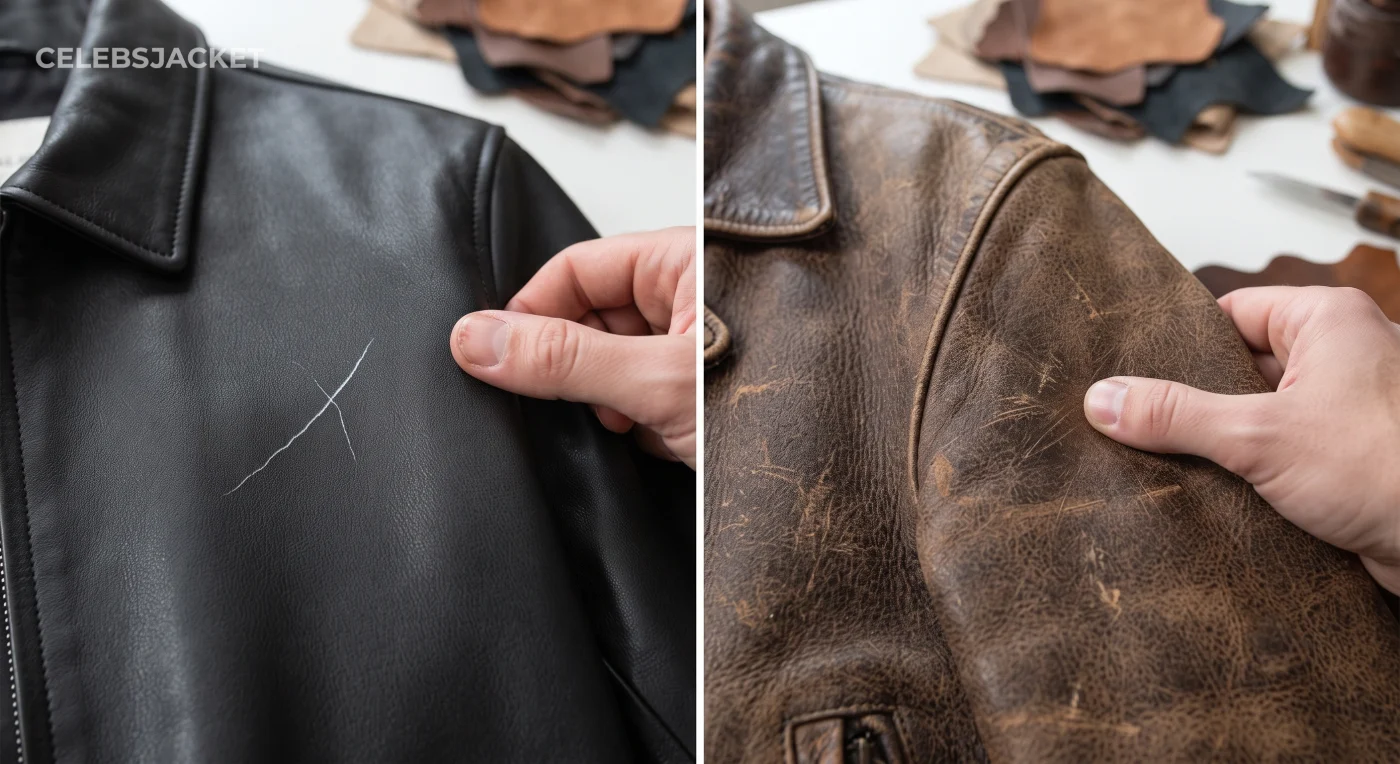
You open up your brand-new lambskin jacket. It is soft and silky. It fits you to perfection. You are feeling like a million dollars. This is when the worst happens. You are going for your car keys, and by mistake your fingernail scrapes against the chest of your jacket. A thin, white streak greets you. Fear takes hold. “Did I just damage my $500 jacket?” This is the nightmare scenario every lambskin owner fears. Unfortunately, there is no magic pen that can solve this problem for lambskin. What hurts even more is that while you are desperately searching Google for “how to remove scratch on lambskin jacket,” your buddy, who purchased a cowhide jacket from the same store, is cracking up. He had scraped the chest of his jacket yesterday with his keys. He simply scratched it and shrugged it off, saying that “it adds character.”
In this guide, we will discuss three actual solutions for lambskin jackets—some of them are effective, some not so much. Then we’ll talk about why cowhide owners simply ignore any damages and don’t repair them.
The Lambskin Panic – Why One Scratch Ruins Your Day
Nothing is quite as irritating as realizing that the first scratch appears on a brand new men’s leather jacket. This may happen in a matter of seconds: one can scratch the sleeve with their nail, touch the leather with a zipper, or even cause a scratch when the garment touches a rough surface. In any case, it’s annoying to realize there is a spot which just didn’t exist a second ago.
There are multiple reasons why this material scratches easily; however, it is clear for everyone that the main one is connected with the properties of this leather. Lambskin is famous for being extremely soft, thus, it is easy to ruin and scratch. Contrary to tough leathers like cowhide, it creates an elegant design but at the cost of sensitivity to damage.
What is crucial to mention is that not all of the scratches mean serious damage. Some of them are caused by the scratches affecting not the material itself but its surface only. There are various ways to remove such marks without making the jacket irreparable but using harsh DIY methods instead.
Finally, it is essential to learn about what makes lambskin so scratchable is also important in terms of setting expectations. When you decide to buy a leather jacket made of lambskin, then you will get the best in terms of comfort, softness, and elegance. However, it will need special treatment, unlike other tougher kinds of leather, like cowhide.
Can Lambskin Scratches Be Repaired?
Method 1 – The Conditioner Trick (Minor Surface Scratches)
In case the scratch is very mild and does not penetrate deep enough, using a good leather conditioner can be enough to make it disappear. Lambskin naturally has oils that make it flexible and soft, and conditioning will help to replenish them while the leather fibers will relax. Thus, very shallow scratches usually fade under the influence of the conditioner.
The scratch needs to be cleaned initially with a dry microfiber cloth. After this is done, put a small amount of a good quality leather conditioner – preferably one containing nourishing components like beeswax or mink oil – on another cloth and not on the jacket itself. The conditioner should be rubbed into the scratch in circular movements, but without applying too much pressure.
After waiting five minutes, the treated spot should be buffed with a separate soft cloth.
It is necessary to remain realistic about expectations though. This procedure is intended to be used for surface-level cuts. If the leather item has been damaged badly enough where the leather itself has been gouged, ripped up, or had its color fully stripped away, then it will not fix the problem. It is also good practice to try any treatment in an inconspicuous area before doing it elsewhere.
Method 2 – Leather Creams and Fillers (Deeper Scratches)
If the scratch goes beyond the surface, causing discoloration or leaving an imprint, an ordinary leather conditioner will not be sufficient. In such cases, the application of a leather repair cream or filler with the matching color should bring the damaged part back to normal, filling up the scratch and making it less visible.
To begin with, make sure that the jacket is perfectly clean and totally dry. Apply a tiny bit of the leather filling cream onto the scratch using a toothpick or another narrow applicator. Don’t spread the filler over the entire leather surface but work in layers and wait for each to dry out before adding more. Once the leather filling cream becomes totally cured, buff it up using a soft cloth.
It should be said that although this approach can considerably help, you should realize that there are certain limits to the use of this kind of products. The leather fillers are made for repairing the damage and not for recreating the initial look of the lambskin. The color can match perfectly but depending on the scratch’s depth and color matching, the place can still be somewhat smoother or flatter than the rest of the leather.
When it comes to high-end or costly lambskin jackets, most experts in the field of leather repair suggest using home-made fillers only when all other options have been exhausted. When the problem concerns a big area, a visible spot, or affects the grain of the leather, professional restoration gives better results.
Method 3 – Professional Dye and Recoloring (Last Resort)
In case of deep scratches, substantial color fading, or extensive damage affecting a large area of the jacket, professional retouching is the solution to improve the condition of the leather product. Professionals will use specific methods of light sanding, filler of damaged spots, and color match to make repairs blend well with the existing finish of the leather.
The price for professional leather restoration will vary between **$100-$300** depending on the degree of the damage and color work. Given the cost, it makes sense to consider professional retouching only in case of expensive leather items that cost **more than $800**. For less expensive jackets, replacing the coat can be cheaper than making all the necessary repairs.
Even if you hire a professional, the result will be far from factory finish. The natural smooth grain and finish of lambskin will be impossible to restore after the damages occur. The jacket must look like it is taken care of; and a professional specialist can help with making repairs barely noticeable for others.
Why Cowhide Owners Don’t Even Look for Scratches
The “Character” Mindset Shift
However, many owners of cowhide jackets have a completely different attitude toward the scratches on them. They do not consider scratches and wrinkles on their jackets as defects but see them as normal for this kind of leather. Scratches, wrinkles, and other signs of aging make cowhide jacket look more alive and increase its uniqueness.
In this case, it depends on the type of leather which is used. Cowhide is more robust and thick than lambskin. During the aging process, cowhide develops patina, which is appreciated by many people and gives additional charm to the jacket. Scratches are easily absorbed by the leather, and they blend with it. That is why scratches are rarely noticed in cowhide jacket.
It is an obvious reason why cowhide is so widespread material for motorcycle jackets, workwear-styled jackets, and vintage jackets for men. Scratches on cowhide jackets make them look unique and experienced, as if the jacket lived through many adventures.
Nevertheless, there are some cases when the scratches require repair. But still, this does not apply to all types of leather and only applies to the delicate and thin lambskin.
The Natural Buffing Effect
Another good feature of cowhide is the density of its fibers, which helps it not leave visible marks in case of small scrapes. Such light scratches tend to blend with the leather over time as the material is used.
If a leather jacket is lightly scratched, the first step to take is to gently massage the area with a thumb or a soft cloth. With the help of such massaging, surface oils might be redistributed over the leather to soften the scratch. It is likely that the use of this easy trick would be enough for many full grain cowhide jackets.
This simple solution should be effective only in case of small superficial scratches. In case if the scratch is deeper and has damaged the leather finish, this method will not work.
The main difference is that cowhide is meant to wear in with time. Scratches are worn in over time by everyday interaction with the leather itself, thus creating a grain on the leather that helps cover up any little blemishes that may have occurred.
The Verdict – Which Leather Wins the Scratch Test?
Cowhide is preferable to lambskin if scratch-resistance is of primary importance since its fiber composition and rough appearance allow scratches to integrate with the material seamlessly. Thus, in many cases, scratches become an inherent attribute of the jacket instead of being noticed right away.
When comparing **cowhide leather jackets** with lambskin ones, the latter is known to be very smooth and extremely soft to touch; however, it may easily show scratches. In general, neither cowhide nor lambskin can be considered worse; the choice of the material is determined by personal preferences since both types of leather have advantages and disadvantages.
The scratches are not the only thing that is important to consider. There are numerous factors that should be taken into consideration while making the final decision regarding what **leather jacket** to choose.
Scratches are only one part of how a leather jacket changes over time. If you’re wondering how lambskin and cowhide compare after years of regular wear—including how they develop patina, soften with age, and handle everyday use—read our guide on the 5-Year Patina Test: Cowhide vs. Lambskin – Which Ages Better? It takes a closer look at how each leather evolves, helping you choose the option that best matches your expectations for the long term.
