
Categorized
How Much Should a Good Leather Jacket Cost in 2026?
Nov
Let’s do quick exercise this afternoon, search online and you will find that you can buy a “leather jacket” for $79 or can spend $7,900 on another one. Both are called leather jackets, and both look good on the hanger. So, what is a fair price for a truly high-quality real leather jacket?
Here’s the answer: In 2026, a good, genuine leather jacket costs between $200 and $600. At this price point, you get high-quality leather jacket made of top-grain lambskin, goatskin, or cowhide. It will come with neat and tidy stitching, and heavy-duty metal hardware that won’t break after just a year or two. If the price is under $150, it is most likely faux leather, bonded leather, or lower-quality leather (split leather). At prices above $1,000, you are paying for thicker, traditional leather, for manufacturing in the U.S. or Europe or for well-known brands.
CelebsJacket has been manufacturing and selling jackets and coats since 2013. In this blog post, we will be addressing one of the questions, which we are asked most often. It is the guide that will show you what you actually get at different price tags and how you can determine whether a jacket is worth its price in just one minute.
Leather Jacket Price Tiers in 2026 (What Your Money Actually Buys)
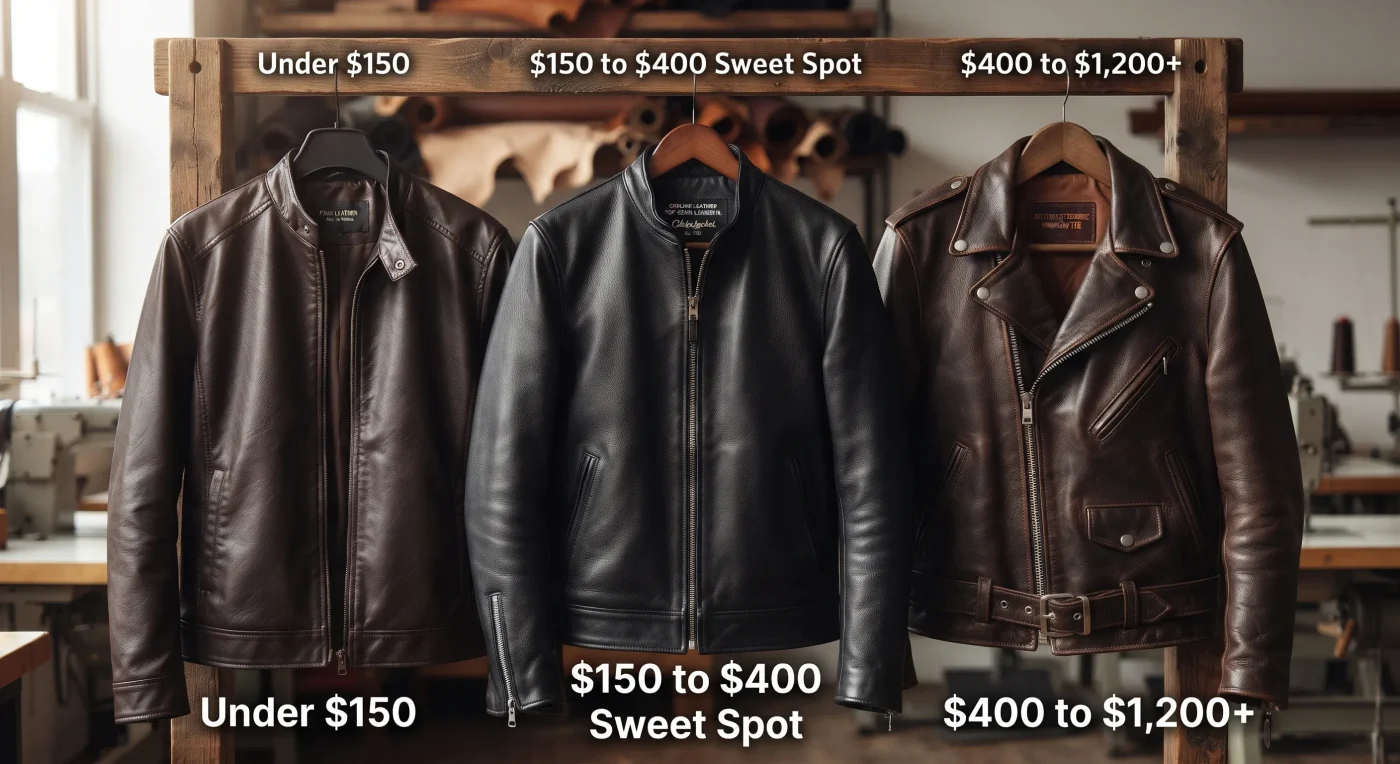
Prices fall into five rough bands. The table gives you the quick version, and the notes below fill in the details.
| Price range | What you usually get | Typical leather | Realistic lifespan | Examples |
| Under $150 | Faux or bonded leather, some split “genuine leather” | Polyurethane (PU), bonded scraps | 1 to 3 years | Fast-fashion racks |
| $150 to $400 | Real top-grain leather from direct-to-consumer makers | Lambskin, goatskin, sheepskin, cowhide | 10 to 15 years with care | Celebsjacket ($150 to $330), Thursday Boot Co. ($349 to $399) |
| $400 to $1,200 | Heavier hides, heritage patterns, US or European workshops | Full-grain or top-grain steerhide, horsehide | 20 years or more | AllSaints (about $650 list), Schott 618 Perfecto ($1,020) |
| $1,200 to $2,000 | Specialty hides and small-batch runs | Horween horsehide, vegetable-tanned leather | Decades | Schott Horween horsehide Perfecto ($1,775) |
| $2,000 and up | Designer labels and runway details | Italian calfskin or lambskin | Decades, if you baby it | Saint Laurent bikers (about $5,000 to $10,000+) |
Under $150: Mostly Faux or Bonded
It is highly unlikely that a brand-new jacket at this price point is made from high-quality (“top-grain”) leather. Terms like “PU leather,” “vegan leather,” or simple and plain “genuine leather” are red flags. While synthetic leather might look good for a season or two, it will eventually start to peel, particularly around the collar and cuffs.
$150 to $400: The Sweet Spot for Most People
This is where you can find the real value. Brands that sell directly to the consumer can offer top-grain leather jackets at such prices. It is so because here, they can bypass the markups charged imposed by large department stores. You may not find a famous brand name on the label at this price point, but you will get a jacket that softens over time. It will conform to your body, and will develop a unique patina. If this is your first real leather jacket, it is the sweet spot.
$400 to $1,200: Heritage Hides and Heavier Builds
It is the price range where the prices rise because the leather gets thicker and the manufacturing process becomes more complex; therefore, it gets more expensive. The “618 Perfecto” jacket by Schott, the famous design-model made famous by Marlon Brando in the film “The Wild One”. It is crafted in New Jersey from cowhide with a thickness of 3.0 to 3.5 ounces and priced at $1,020. It is built to outlive its owner. However, it remains stiff for months at first and feels heavy on the shoulders.
Above $2,000: You are paying for the Name
While designer jackets may feature excellent craftsmanship, beyond a certain point, the extra cost no longer goes toward better leather quality. Instead, it pays for the design, the brand, and the exclusivity.
What Drives the Price of a Leather Jacket?
Two jackets might look identical in a photograph, yet carry a price difference of $500. Below, we are going to explain what accounts for such discrepancy:
Leather Grade
Quality is indeed the decisive factor. With “full-grain leather”, the outer surface of the hide remains entirely intact. It makes it the most durable type and the one that ages the best. Since only a handful hides are flawless enough to meet this standard, it is the most expensive type of leather. “Top-grain” leather is lightly sanded to achieve a smoother, more uniform surface; this type is used for most high-quality fashion jackets. At the lower end of the quality scale, you will find “corrected” leather and what is labeled as “genuine leather.” Our guide to full-grain, top-grain, and corrected-grain leather will show you how to distinguish between these different types.
Hide Type and Thickness
The thickness of leather is measured in millimeters or “ounces” (where one ounce is approximately 0.4 mm, or 1/64 of an inch). Thicker hides are more expensive and require a higher level of craftsmanship to process. A lambskin jacket is typically 0.6 to 0.8 mm thick, giving it a soft, buttery texture and a very light weight. Cowhide, by contrast, usually falls in the 1.0 to 1.2 mm range. Classic motorcycle jackets are even thicker, ranging from 1.2 to 1.4 mm. If a “cowhide” jacket is as thin as a shirt, you should be suspicious.
Tanning Method
Tanning is the process of converting raw hide into usable leather. According to the U.S. Environmental Protection Agency (EPA), approximately 90% of the leather produced in the United States is chrome-tanned. This is a rapid process that results in a soft, water-resistant material. In contrast, vegetable tanning utilizes tannins derived from plant sources; this process takes weeks, which significantly increases costs. For a jacket, chrome tanning does not imply inferior quality; on the contrary, it often results in a better drape of the material. If you are concerned about the origin of the leather, check whether the tannery holds a certification from the “Leather Working Group” (LWG), with the “Gold” rating representing the highest standard.
Construction, Hardware and Lining
Labor costs account for a substantial portion of the total price. A classic biker jacket consists of numerous individual components. Every seam presents a potential opportunity to cut corners on quality. High-end manufacturers use tear-resistant nylon thread, metal zippers from well-known brands. It insides the use of brands like YKK or Talon, and extra stitching at the shoulder seams and pockets. Linings can range from simple polyester or insulating padding to silk in luxury jackets. Since low-quality zippers are usually the first components to fail, they serve as a reliable indicator of overall build quality.
Where It’s Made and How It’s Sold
A jacket manufactured in New Jersey or Italy will incur higher labor costs than one produced in other regions. Even such regions have a long-standing tradition in the leather industry; the production there will be multiple times cheaper. Furthermore, the same goes for the distribution channel. If a jacket moves from the factory through a wholesaler and eventually into a department store, costs are added at each stage. Brands, just like us, that sell their products directly to the end consumer bypass these intermediaries. It can therefore happen that a $300 jacket hangs next to a $700 jacket, while offering comparable quality.
Real vs Faux Leather: Why the Cheaper Jacket Often Costs More
Faux leather is polyurethane applied to a textile backing. While it is cheaper to purchase, it may also attract you, if your primary goal is specifically to avoid animal products. And it is where the advantages end as most faux leather jackets begin to peel after just two to three years. High-quality genuine leather, on the other hand, can last 10 to 15 years, or even longer, with basic care.
Calculating the “cost per use”, which will provide further clarity. Here is a rough comparison, based on the assumption that you wear the jacket about 40 days a year:
| Jacket | Price | Rough lifespan | Total wears | Cost per wear |
| Faux PU biker | $90 | 2 years | 80 | $1.13 |
| Top-grain lambskin | $300 | 10 years | 400 | $0.75 |
| Heritage steerhide | $1,020 | 20 years | 800 | $1.28 |
A jacket in the mid-price range comes out on top. A classic-style jacket is only a worthwhile investment if you wear it very frequently: at 80 days of wear per year, the cost drops to approximately $0.64 per use. Unsure whether a jacket is made of genuine leather? Our guide on “real vs faux leather guide” explains how you can tell the difference by using touch and smell tests, as well as by examining the edges.
Do Men’s and Women’s Leather Jackets Cost the Same?
For the most part, yes! Although a women’s jacket may require slightly less leather, the cutting and assembly processes take roughly the same amount of time, which is why the prices are quite similar. In our collection, most men’s leather jackets are priced between $160 and $330, while women’s styles range from $150 to $330. Prices may also vary depending on the style. Women’s designs often feature elements such as draped collars, cropped cuts, fur trim, or waist belts, each of which requires additional labor. In terms of design, women’s garments are therefore frequently more expensive than men’s. Conversely, in men’s fashion, biker jackets, made from thick leather, and flight jackets with shearling tend to be higher-priced, as they require more material and heavier insulation. Our men’s leather jacket buying guide provides more detailed information on the various styles and how the garments fit.
How to Tell if a Leather Jacket Is Worth the Price (A 60-Second Check)
You do not need to be an expert to judge a jacket. Run through this list and you can do the inspection by your own.
- Pay attention to the animal species and the quality. “Top-grain/full-grain lambskin ” is an accurate description. Vague terms “genuine leather” without specifying the animal species, is often a misleading marketing claim.
- Examine an exposed edge. For example, look inside a bag or along a hem. Real leather has a fibrous underside with a velvety texture, whereas synthetic leather typically features a textile backing layer.
- Check the zipper. A sturdy, solid-metal zipper from a well-known brand is always a good indicator of quality. Conversely, lightweight, flimsy sliders often break easily mean otherwise.
- Inspect the seams, especially in areas subject to high stress. At the shoulders, armholes, and corners of pockets, the stitching should be tight and uniform; there should be no loose threads.
- Consider weighing the jacket. A jacket made of genuine cowhide should have a certain heft. If it is as light as a windbreaker, it likely does not match the description.
- Check the return policy. A seller who offers a 30-day trial/return period demonstrates confidence in their product.
If a jacket passes all six, the price is probably fair, whatever the number is.
Frequently Asked Questions
Q: Can you get a good leather jacket for under $200?
A: Yes, but be cautious. Look for top-grain/full-grain lambskin or goatskin from a direct-to-consumer brand. You can also buy secondhand from eBay. Brand-new jackets under $150 are rarely real leather ones.
Q: How long should a good leather jacket last?
A: A high-quality top-grain/full-grain leather jacket can last 10 to 15 years with basic care. Treat the leather with a conditioning product every few months and store it on a wide, padded hanger.
Q: Is buying a used leather jacket a smart way to save money?
A: Often, yes. High-quality leather is durable enough for a “second life.” For instance, vintage Schott 618 jackets have recently sold on eBay for $300 to $600, roughly half their original retail price.
Q: Why do some jackets only say “genuine leather”?
A: Technically speaking, that is correct. The term “genuine leather” usually refers to a lower layer of the hide. It is obtained through a splitting process, which is often sanded down and finished with an artificial surface.
The Bottom Line
Plan for a budget between $150 and $400. It will get you a genuine leather jacket that can last a decade or more. If you spend less, you run the risk of ending up with a synthetic, plastic-based product. If you choose to invest more, ensure that the higher price is due to thicker leather or superior craftsmanship, rather than just a brand logo.
When you are ready to make a purchase, take a look at our leather jackets for men and women’s leather jackets. Each product page specifies the exact type of leather used, so you know exactly what you are getting for your money.
