
Men Jackets
Men’s Leather Jacket in Lambskin: The Complete Guide — What Nobody Tells You About Quality, Feel & Value
Jun
A high-quality men’s leather jacket makes its distinction quite evident. A heirloom‑grade fashion piece doesn’t just look good due to its detailed construction or the brand its associated with – it achieves this milestone because of the quality leather being used. There are so many different types of leather being used the garment. But one type of leather (aviator jacket brown leather and other similar outerwear jackets manufacturing in particular) that has earned a distinctive place. It is the Lambskin leather that attracts the attention from fashion specialists and luxury designers.
There are so many reasons why the Lambskin is highly sought after by the fashion industry’s connoisseurs. It is due to its incredible softness, the presence of very fine grain texture, and superlative-elegance. It is to be understood here that where these properties make the lambskin so desirable and tempting, the same qualities also make it fragile and prone of damage without proper care. However, after reading this guide, you will have expert-level knowledge about lambskin and the knowledge gap gets bridged to a great extent.
1. What Is Lambskin Leather? (And How It Differs From Sheepskin)
The lambskin leather is extracted from the hide of young sheep (often termed as a Lamb). It is generally less than one year old. Because of its young age, the collagen fibers in its hide are finer and delicate compared to those fully grown mature sheep. This is the prime factor behind the renowned butter-like softness associated with it.
There is one clear misconception about the lambskin and we should definitely address it. Many people often think that the lambskin and sheepskin is interchangeable and they both actually refer to a similar type of hide. However, it is not true. The truth is that they are different. Whereas the sheepskin leather comes from the hide of fully a grown / adult sheep, has a coarser grain, it is also less elastic and less supple than the lambskin leather. For a smoother, elastic and silky-soft material, the lambskin has always been a superior and practical choice. Another decisive factor is since the shearling has been completely removed from it leaving a smooth and fine grain, it also develops the quality of absorbing dyes very well.
Why Age Matters
As in case of lambskin where the animal is younger, the hide is also thinner and so will be the collagen bundles. It comes with three noticeable benefits:
- Less thicker (thickness ranges in-between 0.5–0.8 mm) compared to cowhide (1.0–1.4 mm).
- Less weight jacket (800–1200 grams) versus cowhide (1500–2500 grams).
- Lanolin content is higher — is the fat that naturally lubricates fibers within.
This is the reason why lambskin men leather jacket is comfortable upon initial wearing, as barely needs a break-in period in contrast to a cowhide leather jacket that does need that.
2. Why Is the Lambskin leather Ideal Choice for Superior Menswear?
Lambskin is so much more than a “soft” material. The unique characteristics, those which have been discussed above, make it a preferred choice of material, particularly in the men’s leather jackets category.
Below are some highlights that make it highly suitable in manufacturing fashion outerwear:
| Property | How it makes a difference |
| Butter-soft | No stiffness or fine texture. It molds to your body immediately. |
| Lightweight | Add to its elegance making it ideal for mild weather. You enjoy your leather jacket without any fatigue. |
| Excellent fall | It hangs naturally. Every the slim fit styles look clean and redefined. |
| Dye acceptance | The result is rich and even. Won’t look washed out even after years of usage. |
| Breathability | Due to the porous nature of the hide, the moisture vapors are easily let out thus, totally avoiding the uncomfortable feeling. |
Whether it is a trip, commuting to the office or a party with friends, lambskin hits that perfect spot where it balances elegance and comfort. As its admirers after say, it is the kind of a “leather you want to wear it in, not just look at it.”
3. How to Identify High Quality Lambskin and How to Avoid Low Grade Leather?
| Grade | Description | What to Expect |
| Full‑grain | The top tier. It is layer of the hide that is completely untouched. Pores, natural grain and even scars can be seen clearly. | It is the gold standard. It develops a beautiful patina and can last a lifetime. |
| Top‑grain | The second tier. Still a premium choice. The surface is lightly sanded to get rid of the imperfections. | High quality, but will hardly develop the same patina as the latter one. |
| Genuine leather | Can be misleading. May come from the lower layers after the top-grain has been stripped away. | It is the real leather but is less durability. Often vey lightweight and dull. |
| Bonded leather | Leather scraps bonded together with glue Comes embossed with an imitation surface. | No real leather at all. Falls apart after only a couple of years. Not recommended at all. |
Five Tests to Condust Through Senses Before Making a Decision
- By smelling: Natural lambskin will have an earthly smell. Some people would also find that smell appealing. Fake leather will smell like plastic or chemical glue.
- By inspecting the grain: Look for the imperfections on grain. Pores, scars, uneven texture variance. Faux leather will have repeated stamped pattern across the entire surface.
- By pressing: Apply gentle pressure with your thumb. Natural lambskin will have wrinkle and leaves crease, then slowly relaxes again. Faux leather on the other hand either will remain flat or bounces right back, like sponge.
- By checking the edges: Cut edges should show the characteristics of natural leather: fibrous and evenness of color all throughout. While the edges of synthetic leather are smooth with fabric backing.
- By gauging the weight: A regular lambskin jacket would weigh around 800–1200 grams. If it feels otherwise, be careful. Faux leather will weigh less and contains artificial fillers.
4. Lambskin vs. Cowhide vs. Goatskin: A Data Driven Comparison
The most frequent challenge the shoppers have to face is determining whether to opt for lambskin, cowhide, or goatskin. As every type of natural leather has its unique characteristics, the following table all tell you everything that is required:
| Attribute | Lambskin | Cowhide | Goatskin |
| Source | Young sheep (<12 months) | Adult cattle | Adult sheep |
| Thickness | 0.5 – 0.8 mm | 1.0 – 1.4 mm | 0.6 – 1.0 mm |
| Jacket weight | 800 – 1200 grams | 1500 – 2500 grams | 1000 – 1800 grams |
| Softness | Highest | Moderate | Moderate (softer than cowhide) |
| Break‑in period | None – 5 wears | 15 – 20 wears | 5 – 10 wears |
| Breathability | Excellent | Moderate | Good |
| Abrasion resistance | Moderate | Highest | Good |
| Water resistance | Low | Moderate | Best (has lanolin) |
| Lifespan (with care) | 10 – 25 years | 15 – 50 years | 10 – 30 years |
| Best for | Fashion, all‑day comfort, warm weather | Heavy‑duty work, riding, cold climates | Lightweight structured jackets, travel |
Which One Should You Choose?
- Lambskin → If you value comfort, lightness, and elegance. Perfect for day-to-day usage in the city and during the mild weather conditions (approx. 7–21°C).
- Cowhide → If you desire toughness and durability. Cowhide will protect you as a rider, and is best for outdoor workers, or anyone who faces a lot of wear and tear. Heavier than lambskin but more durable.
- Goatskin → This is somewhere in-between lambskin and cowhide. Its pebble-like grains hide little scuffs and cuts better while being lighter yet tougher than cowhide. Great choice for outdoors and traveling.
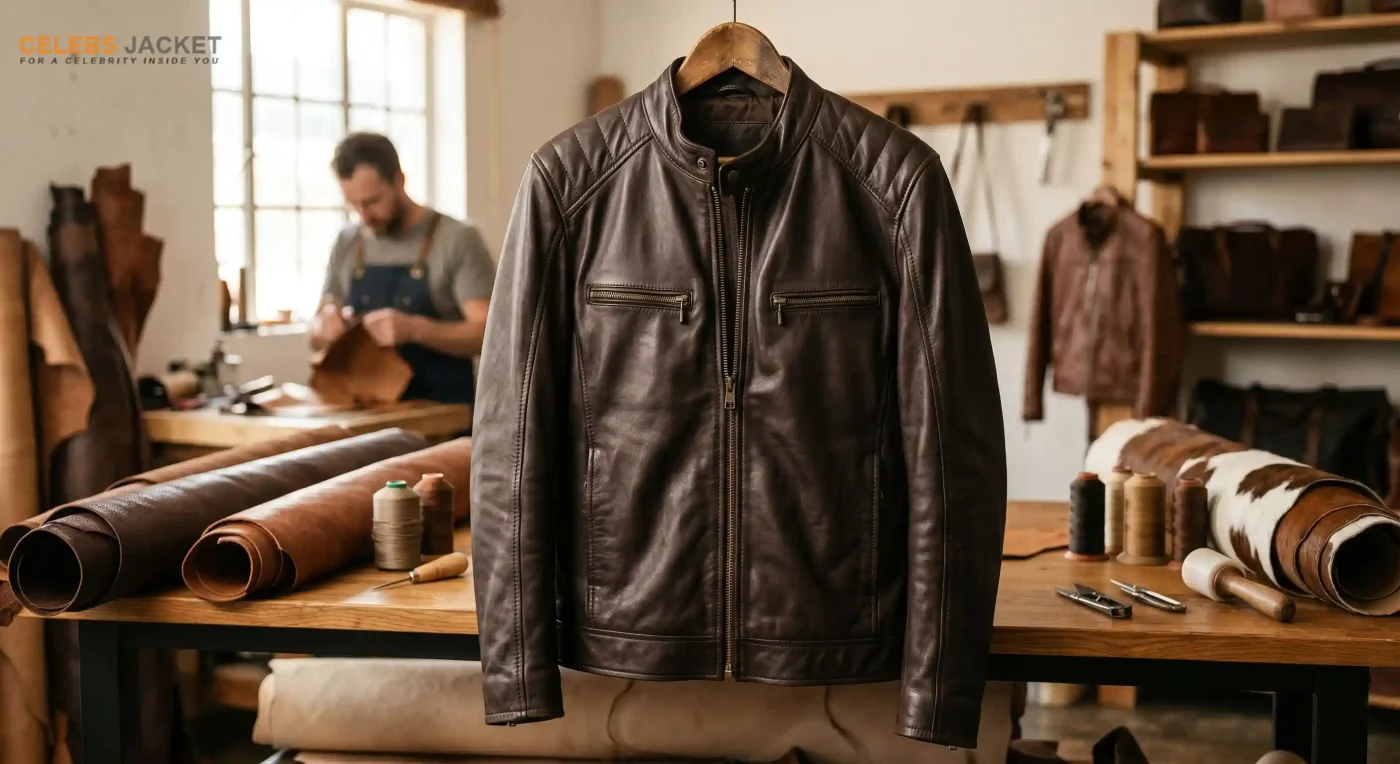
5. The Craftsmanship Journey: How a Lambskin Jacket Is Made
Learning about the production of lambskin jacket helps one to appreciate good quality. The following are simplified steps showing the way it is made in the skilled artisan workshops.
Step 1 – Hide Selection
Experienced craftsmen select hides from approved tanneries. The hides must have consistent fiber thickness and be of full-grain or top-grain lambskin without any defects.
Step 2 – Tanning
The hides go through the process of tanning in order to stabilise the collagen fiber. There are two common types of tanning:
- Chrome tanning – This tanning process is fast but makes leather softer. It is preferred in making today’s lambskin jackets.
- Vegetable tanning – The tanning takes longer but uses natural substances. It gives leather that improves with age and develops richer patina. Favorite choice by the heritage brands.
Some tanneries have been certified under (LWG) the Leather Working Group. It ensures environmental responsibility and traceability.
Step 3 – Pattern Making and Cutting
In contrast with mass-produced artificial jackets, fine quality lambskin leather jackets are usually hand-cut. The pieces of pattern are cut keeping in view the orientation of the grains and the stressed areas such as armholes, shoulder seams are always cut from the toughest portions of the skin.
Step 4 – Stitching
Stitching leather material is done in one go; i.e. if a hole is made using needle then it does not close. Expert tailors use special machines along with strong nylon/polyester threads to stitch the leather jackets.
Step 5 – Lining and Finishing
The lining of the jacket is made of breathable fabric like polyester, viscose, or sometimes even cotton. This is done without making any folds and after checking all the buttons and fasteners.
✨ Takeaway for buyers: The greater number of tasks that need to be done manually from picking out the leather to inspecting the end product, the better the quality of the jacket. The mass production process cannot yield the same quality as the artisanal workshop.
6. Care and Maintenance: Extending the Life of Your Lambskin Jacket for 10–25 Years
Taking proper care of lambskin is more complicated compared to cowhide, but it is manageable enough. The most common reasons for wear out are over cleaning and ignoring the conditioning process.
Weekly Care
- Dust and wipe with a soft and dry microfiber.
- Clean your jacket’s pockets for any sharp items that might leave marks on the leather from within the pockets.
Monthly Inspection
- Inspect the presence of any darkened areas (oiling or water spots) and deal with them promptly.
- Conduct seam inspection, particularly at the shoulder and armpit areas.
Deep Cleaning (Every 3–6 months)
- Set your jacket in a flat position.
- Moisten a piece of cloth with warm water (do not saturate it). Rub the entire surface in gentle, circular motions.
- For a soiled leather jacket, apply mild pH balanced leather cleaner. You should completely avoid dishwashing detergent or bleach.
- Air dry the jacket using a padded hanger in an area devoid of direct sunlight and heat sources.
Conditioning (Twice a year, or once a year for light use)
- Silicone-free leather conditioner is suitable for sensitive leather types is required.
- It must be applied in thin and uniform coats using a cloth.
- The conditioner should be absorbed for 15 to 20 minutes before polishing with another clean cloth.
- This treatment restores the natural oils in the leather, helps prevent cracking, and keeps its unique lambskin softness.
What to Avoid – The “Never” List
| Mistake | Consequence |
| Machine washing | Leather shrinks and gets permanent cracks. |
| Dry cleaning (standard) | Removes essential oils leaving it stiff. |
| Direct sunlight or radiator drying | UV rays fade away color. Intense heat also causes cracking. |
| Using silicone based “shining” sprays | Chokes natural pores; takes away breathability. |
| Storing in plastic garment bags | Traps moisture inside. leadings to mildew and mould. |
🧼 Note: For tough stains such as ink, oil, or blood, seek professional help as home remedies may damage the skin permanently.
7. How to Style Your Lambskin Leather Jacket for Every Season
A good lambskin jacket can be used not only in winter but also in up to three, and in some cases four, seasons
Autumn (Fall)
- Ideal conditions: 10–18°C / 50–65°F.
- Styling tips: Pair your jacket with an oversized knit sweater or a flannel shirt. Wear it with dark jeans and leather shoes. Pairing the smooth jacket with a rough sweater will enhance its appearance.
Winter (Cold)
- Ideal conditions: 0–10°C / 32–50°F.
- Styling tips: Start with a thermal layer, followed by a thin turtleneck, and complete the look with your lambskin jacket. Wear a woolen scarf and gloves. Since lambskin is more lightweight than cowhide, it is easy to wear it over mid-weight clothing.
Spring
- Ideal conditions: 12–20°C / 54–68°F.
- Styling tips: Team up with a basic white or black t-shirt, chinos, or tailored slacks along with low-top sneakers.
Summer (Cool Evenings Only)
- Ideal conditions: below 22°C / 72°F.
- Styling tips: Put your jacket across your shoulders or just leave it unbuttoned. You can combine your jacket with linen shirts, and choose only light colors for jackets (cognac, tan or beige).
👕 Pro tip: A close-to-the-body yet comfortable fit is recommended for a lambskin jacket. A slim fit lambskin jacket will be suitable for most occasions; wearing an oversized one would be a streetwear style statement.
8. Sustainability, Ethics, and Long Term Value
Today, most people not only ask “How does it look?” but they are also interested in knowing “Where did it come from?” and “How long it will last?”
Ethical Sourcing
Even the most expensive lambskin is also by-products from the agriculture industry. No animal is bred solely to produce leather. Reputable manufacturers always obtain their hides from ethical tanneries adhering to the rules of humane treatment of animals.
LWG Certification
The Leather Working Group (LWG) conducts its inspections on the basis of environmental criteria including consumption of water, chemicals, and energy efficiency. Jackets made of LWG certified leather are traceable.
Long‑Term Value (Cost‑per‑Wear) A high-quality, properly maintained lambskin jacket will last from 10 to 25 years on average. Consider that synthetic, vegan leather jackets start peeling and cracking within 1 or 2 years after purchase.
| Purchase | Price | Lifespan | Cost‑per‑year (approx.) |
| Premium lambskin jacket | $350 – $800 | 10–25 years | $14 – $80 |
| Mid‑range cowhide jacket | $150 – $250 | 15–20 years | $12 – $33 |
| Faux leather jacket | $60 – $150 | 1–2 years | $30 – $150 |
The conclusion: Although the initial cost of a lambskin jacket may be higher than a synthetic leather alternatives, the cost per wear will be less when compared to a low-quality alternative that needs replacing within eighteen months.
Frequently Asked Questions (FAQs)
A: Indeed, for regular activities like commuting and office work. But for motorcycle riding, it is not the right one to use. Cowhide or goatskin would be better choices here.
A: Seek out these signs:
1. Mentioning of “100% lambskin” (rather than simply saying “genuine leather”).
2. High-resolution photos display a natural pattern of grains even scars.
3. It’s not unreasonably priced because real lambskin can’t be less expensive than an excellent meal.
A: The utilization of 1.0mm to 1.2mm leather, authentic Sherpa lining, heavy-duty YKK hardware, bonded nylon thread and a fit that flatters without being restrictive make our jackets stand out.
A: To some extent, yes. The material adjusts to your body according to the usage. It is a characteristic, not a defect, but it will not fit several sizes; it only adjusts itself to fit perfectly.
A: It is alright if there is some light rainfall; just wipe it off using a soft cloth. However, heavy rain or getting the lambskin soaked is not advisable since lambskin can absorb water. In case it does get wet, just leave it to air dry without using the radiator or hair dryer.
A: The reason behind it is:
1. Full-grain versus top-grain versus corrected grain;
2. Handmade versus mass production;
3. Brand image and designer’s margin; and
4. Tanning process (vegetable tanned lambskin is typically more costly).
A: Vegan leather is not only made out of oil-based materials but also non-biodegradable, and its lifespan is limited to about 1-2 years due to peeling. Lambskin leather is a renewable resource and has a lifespan of ten times more than vegan leather.
10. Conclusion: Why This Guide (and Your Jacket) Deserve Attention
We’ve discussed: from the collagen fibers’ micromorphology to practical solutions of cleaning a stain with oil, from misleading labeling of “genuine leather” to comparison tables that help you make informed decisions.
Recap of the Three Core Ideas
- Lambskin is not delicate: It is unique. Its delicacy, flexibility, and lightness are deliberate attributes and not liabilities, and with proper care, it lasts ten times longer than any artificial substitute.
- Trust should be your most valuable asset: When looking for jackets or even reviewing vendors, trust and transparency come first. Genuine craftsmen will show you the grain, welcome all your questions, and allow returns. Fake sellers use pixelated images and “imposter” domain names.
- The relationship with your jacket is mutual: It provides you with comfort, with style, with substance. You in turn dedicate a total of ten minutes twice a year to its lasting heirloom.
Final Thought
lambskin men’s leather jacket is not a fad; it is an investment that calls for commitment, dedication, and knowledge. The world of leather clothing products is now flooded with copycats and poor-quality leather materials, yet the real deal, which includes a soft, expertly stitched, and professionally tanned lambskin jacket, remains hard to ignore.
It is now time to make your move after learning everything there is to know about identifying lambskin jackets, testing their authenticity, and ensuring that they stay relevant for years to come.
Ready to own the best lambskin jacket? Browse our New In range or talk to our leather experts today!
